
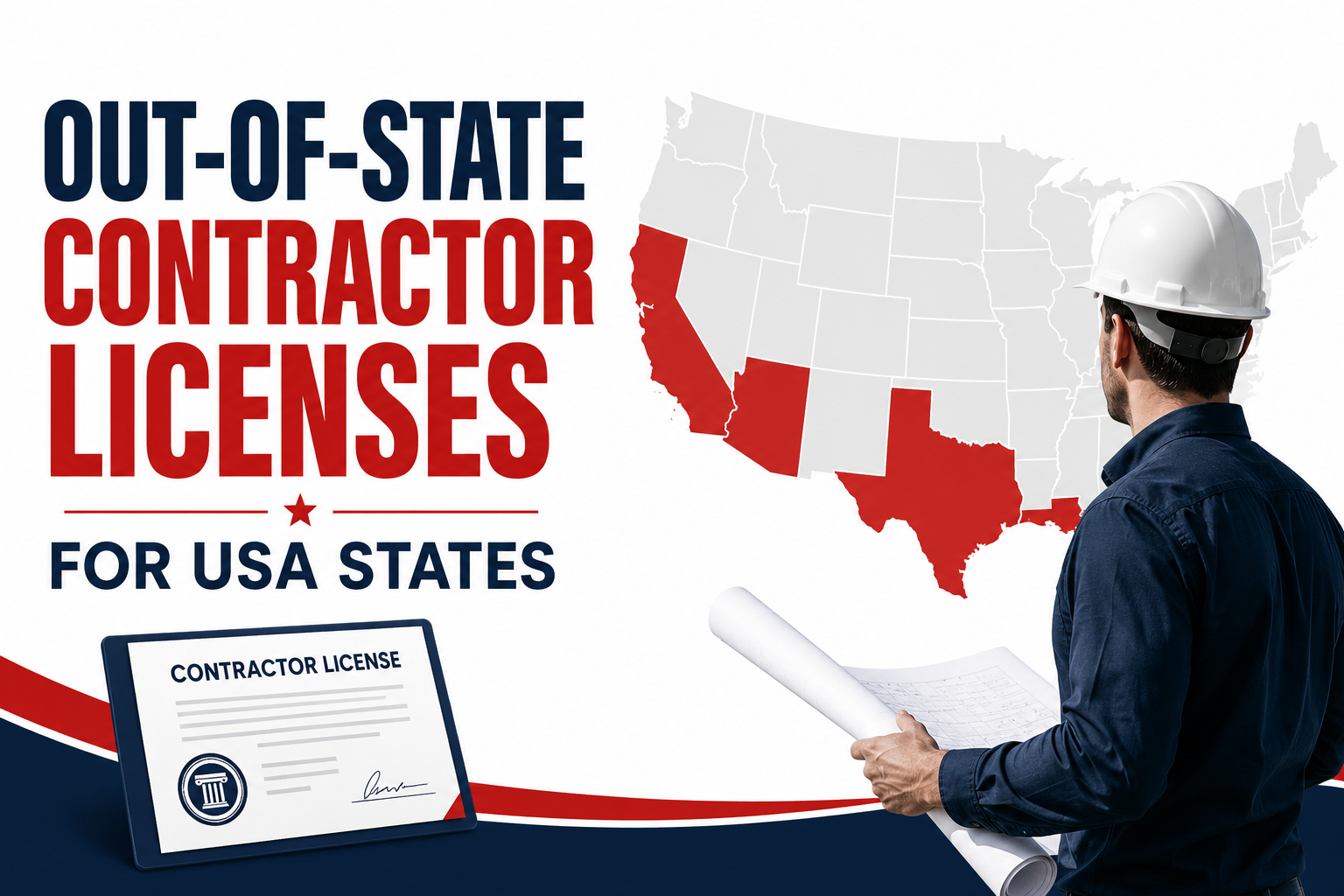
You’ve built a successful contracting business in one state, and now opportunity is calling from across state lines. Whether it’s a booming construction market in Florida, a massive commercial project in Texas, or a high-value residential job in California, the question is always the same: how do you legally get to work?
Obtaining an out-of-state contractor license doesn’t have to mean starting from scratch. Depending on where you’re currently licensed and where you want to work, there are faster legal pathways — including reciprocity agreements and license by endorsement — that can get you permitted and on the job site in a fraction of the time it takes to go through full licensure.
This guide breaks down exactly what out-of-state contractors need to know about working legally in Florida, Texas, and California — three of the most active construction markets in the country.
Why Your Home State License Isn’t Enough
Contractor licensing in the United States is regulated at the state level, and in some cases at the county or city level. That means your Georgia contractor license, your Tennessee license, or your North Carolina license — no matter how clean and well-established — does not automatically authorize you to pull permits or perform licensed work in another state.
Working without a valid license in a state that requires one can result in:
- Stop-work orders on active job sites
- Heavy fines and civil penalties
- Criminal charges in some states
- Voided contracts and inability to collect payment
- Permanent damage to your professional reputation
The good news is that most states have recognized the need for smoother interstate mobility for licensed professionals, and several have developed formal pathways to make the process faster.
The Three Main Pathways for Out-of-State Contractors
Before diving into state-specific requirements, it’s important to understand the three primary licensing pathways available to out-of-state contractors:
1. Reciprocity
Reciprocity is a formal agreement between two states that recognizes each other’s licensing standards as equivalent. If you hold a license in a reciprocal state, you may be able to obtain a license in the new state without retaking the full exam — sometimes with just an application and a fee.
Important: True reciprocity agreements between states are less common than many contractors assume. Always verify current reciprocity status directly with the state licensing board, as these agreements can change.
2. License by Endorsement
Endorsement is the most widely available pathway for out-of-state contractors. Under endorsement, a state reviews your existing license, exam scores, experience, and qualifications. If they meet the state’s standards, you’re issued a license without having to retake the full examination.
Endorsement is not automatic — you still go through an application process — but it’s significantly faster than full licensure from scratch.
3. Examination (Full Licensure)
If neither reciprocity nor endorsement is available for your license type, you’ll need to apply for full licensure, which typically requires passing the state’s contractor exam, submitting proof of experience, securing insurance and bonding, and paying all applicable fees. This is the longest path but sometimes the only option depending on the state and trade.
How to Work in Florida as an Out-of-State Contractor
Florida is one of the most sought-after construction markets in the country, and it also has one of the most comprehensive contractor licensing systems. The Florida Department of Business and Professional Regulation (DBPR) oversees contractor licensing through the Construction Industry Licensing Board (CILB).
Does Florida Have Contractor License Reciprocity?
Florida does not have broad reciprocal contractor license agreements with other states. However, Florida does offer licensure by endorsement for contractors who hold a valid license in another state and meet Florida’s qualification standards.
Florida Contractor License by Endorsement
To obtain a Florida contractor license by endorsement, out-of-state applicants generally need to:
- Hold a current, active license in another state in the same contractor category
- Have passed an approved contractor examination (such as the Prometric or PSI exam) with a qualifying score
- Demonstrate the required years of experience in the trade
- Provide proof of general liability insurance and workers’ compensation coverage
- Submit a completed application with all required documentation to the DBPR
- Pay the applicable application and licensing fees
Key license types in Florida include Certified General Contractor (CGC), Certified Building Contractor (CBC), and various specialty licenses (electrical, plumbing, roofing, HVAC, etc.). Each has its own experience and examination requirements.
Florida’s Certified vs. Registered Contractor Distinction
Florida has a unique two-tier licensing structure that out-of-state contractors must understand:
- Certified Contractors are licensed statewide and can work anywhere in Florida without additional local approval.
- Registered Contractors are licensed locally and must register their license with each county or municipality where they want to work.
For out-of-state contractors looking to operate across multiple Florida counties, pursuing a Certified license is almost always the smarter, more efficient choice.
How Long Does Florida Endorsement Take?
Processing times for Florida contractor license applications typically range from 4 to 12 weeks, depending on application completeness and current DBPR volume. Incomplete applications are a leading cause of delays — make sure every document is in order before submitting.
How to Work in Texas as an Out-of-State Contractor
Texas is the second-largest construction market in the United States, and it has a uniquely decentralized licensing structure compared to most states.
Texas Contractor Licensing: The Big Difference
Unlike Florida or California, Texas does not have a statewide general contractor license requirement. General contractors in Texas can legally work across most of the state without holding a state-issued GC license. However, this does not mean Texas is a free-for-all.
Several important factors apply:
- Specialty trades are licensed statewide — Electrical, plumbing, HVAC, and other specialty contractors must hold a Texas state license issued by the applicable state agency (TDLR for HVAC and electrical, Texas State Board of Plumbing Examiners for plumbing, etc.).
- Local jurisdictions matter — Many Texas cities, including Houston, Dallas, San Antonio, and Austin, have their own contractor registration or licensing requirements. Out-of-state contractors must verify local requirements before starting work.
- Commercial projects may have additional requirements — Projects over certain dollar thresholds or involving specific occupancy types may trigger additional registration requirements.
Out-of-State Specialty Contractors in Texas
For specialty trades, Texas does offer reciprocity or endorsement pathways with certain states for electrical and plumbing licenses. The Texas Department of Licensing and Regulation (TDLR) reviews applications from out-of-state licensees on a case-by-case basis.
If you hold a journeyman or master electrician license in another state, for example, TDLR may waive certain exam requirements if your home state’s standards are deemed equivalent to Texas standards.
Practical Advice for Out-of-State GCs in Texas
If you’re a general contractor looking to work in Texas:
- Verify whether your specific city requires local contractor registration
- Ensure all subcontractors you use on Texas jobs are properly licensed under Texas state law
- Secure Texas-compliant general liability and workers’ comp coverage
- Check whether your project type triggers any Texas-specific requirements (mechanical, fire protection, etc.)
How to Work in California as an Out-of-State Contractor
California has arguably the most rigorous contractor licensing system in the United States. The California Contractors State License Board (CSLB) regulates over 50 license classifications, and the state takes unlicensed contracting extremely seriously.
Does California Offer Contractor License Reciprocity?
California does not offer reciprocity with any other state for contractor licenses. Every out-of-state contractor who wants to work legally in California must go through the full California licensing process — regardless of how long they’ve been licensed elsewhere.
California Contractor License Requirements for Out-of-State Applicants
To obtain a California contractor license as an out-of-state applicant, you must:
- Have at least four years of journeyman-level experience in the trade within the last ten years
- Pass the California contractor license exam (a trade exam plus a law and business exam)
- Submit a complete application with verified experience documentation
- Provide a contractor’s bond ($25,000 as of current CSLB requirements)
- Carry workers’ compensation insurance or file a valid exemption
- Pass a criminal background check
There are no shortcuts or fast-track options in California. Your experience and credentials from another state may satisfy the experience requirement — but the exams are mandatory for everyone.
California Contractor Exam Preparation
The CSLB exam covers state-specific construction law, business practices, and trade knowledge. Out-of-state contractors who have operated under different state regulations often underestimate the importance of California-specific exam prep. Investing in a CSLB-approved exam prep course is strongly recommended.
Processing Times in California
CSLB application processing can take anywhere from 3 to 6 months or longer. California is known for thorough background checks and experience verification. Plan your project timeline accordingly if you’re pursuing California licensure.
Reciprocal Contractor License States: What to Know
While full interstate reciprocity is rare, some states do have partial agreements or streamlined endorsement processes worth knowing:
- Louisiana and Mississippi have historically maintained reciprocity for certain contractor license classifications.
- Alabama offers endorsement pathways for contractors licensed in states with equivalent exam standards.
- Georgia has licensing endorsement provisions that recognize certain out-of-state exam scores.
- North Carolina reviews out-of-state applications under an endorsement framework for General Contractors.
- Nevada offers reciprocity with certain states for specific trades.
Always verify current agreements directly with the applicable state licensing board. Reciprocity agreements can be added, suspended, or modified, and information online is not always up to date.
Tips for Out-of-State Contractors Pursuing Multi-State Licensure
If you’re planning to operate in multiple states, a proactive approach to licensing saves significant time and money:
Start early. Licensing timelines of 3–6 months are normal. If you know a project is coming in a new state, begin the application process as soon as possible.
Keep your documents organized. Most states require certified copies of your current license, exam scores, experience verification, insurance certificates, and financial statements. Having a complete licensing package ready speeds up every new application.
Use a licensing consultant. Multi-state contractor licensing services can manage applications, track deadlines, and ensure compliance in multiple jurisdictions simultaneously.
Understand local requirements. State licensure is often just the first layer. County and city requirements can add additional registration steps, fees, and insurance minimums — especially in large metro markets.
Never work on a license you don’t hold. The temptation to “start the job while the license is processing” is one of the most common and costly mistakes out-of-state contractors make. A stop-work order on a half-finished commercial project can cost far more than any licensing delay.

Summary: Out-of-State Contractor License Pathways by State
| State | Reciprocity | Endorsement | Full Exam Required | Timeline |
| Florida | No | Yes | Sometimes | 4–12 weeks |
| Texas (GC) | N/A | N/A | No state license required* | Varies by city |
| Texas (Specialty) | Partial | Case-by-case | Sometimes | 4–8 weeks |
| California | No | No | Always | 3–6 months |
Texas GC: local jurisdiction requirements still apply
Final Thoughts
Navigating the out-of-state contractor license process is one of the most important steps you can take to protect your business when expanding into new markets. Florida, Texas, and California each offer major construction opportunities — but they also each carry significant legal risk for contractors who aren’t properly licensed.
Whether you qualify for a contractor license by endorsement, need to pursue full licensure, or are exploring reciprocal contractor license states, the key is to start the process early, prepare your documentation thoroughly, and never assume your home state license covers you elsewhere.
Working with a contractor licensing specialist or construction attorney who understands multi-state requirements can save you months of back-and-forth with state boards — and keep your projects moving forward without interruption.
Ready to expand your contracting business across state lines?